From an Oblique Angle
  • Home
  • Blog
  • Bigfoot: The Life and Times of a Legend
  • The Fire Ant Wars
  • The Forteans
  • Articles
The Artist: Ralph Rayburn Phillips, part I 07/14/2010
0 Comments
 
Picture
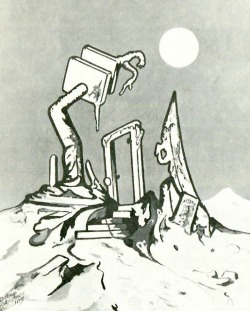
From Destiny 7, Winter 1953.
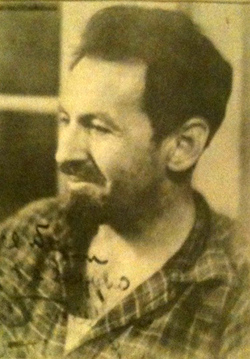
Ralph Rayburn Phillips did not live in the Bay Area—he was a Portlander.  But, he did come to the Bay Area often, and was among those who dropped in on the Fortean meetings, at least according to Don Herron.  And so I have included him here, among the Bay Area Forteans.  There’s not a lot on Phillips, but it is possible to piece together an outline of his life from census records, a file held at the Portland Art Museum, and a brief biographical sketch in the spring 1953 issue of the fanzine Destiny.

Ralph was born to George T. and May G. on 17 October 1896 in Rutland, Vermont.  George T. was a native Vermonter—as were his parents—born just after the end of the Civil War in August 1865.  May G. was just a little younger than her husband, born in March 1866 to a couple who had emigrated from Canada.   They were married in 1892, when both were in their late twenties.

George’s father had been a farmer and car inspector; May’s had been a carpenter.  George became a dentist.  The family seemed to start out in good financial standing: by 1900, they owned their home, free and clear.

Ten years later, still in Rutland, Vermont, the house became a bit fuller.  According to the census, they took on a boarder from French Canada, and May’s parents, Joseph and Philament Harper were also living with the Phillips.  Later evidence also suggests that Ralph had two younger sisters, although they were not captured by the 1910 census.  George was the only one working: he was called a “physician.”  Ralph was then a student—at “Eastern public schools,” where he studied art.

As he remembered much later, Ralph was a rebel from an early age.  He told the Oregon Journal in 1970, “I remember walking out of a Baptist Church in anger.  I learned early to hate hopeless conformity.”

By 1920, the family had relocated to Portland, Oregon, without the boarder or May’s parents, who had likely died by this time.  According to a brief biography down for a fanzine, the move came when Ralph was eighteen, so about 1914.  George now sold farm implements, which seems a step down in prestige, although the family did still own its home.

According to his later recollections, Ralph had continued to study art at high school in Portland, and apprenticed to a commercial artist.  The census backs this up, listing his career as commercial artist.  (He was still living at home, and so it is likely helped contribute to the family finances.)  At some point—maybe in the 1910s, maybe later—he also attended the School of Applied Art in Battle Creek, Michigan.

Sometime in the next ten years, George died, and the family’s fortunes declined.  By 1930, they had moved into a rental, and Ralph took a new job—as an organizer and salesman for a fraternal order.  The monthly rent was a rather steep $25, but the house had to be big enough to fit Ralph, his mother (who was not working), his sister Iris.  Iris had just married a marine engineer, James C. Barrie, but he was at sea when the 1930 census was conducted.  Nonetheless, the artistic spirit continued to flow through the family.  Iris listed her occupation as poet—a brave choice, indeed!

Ralph would live in Portland until his death in 1974, going from Bohemian to Beatnik to Hippie.  The Oregon Journal reported in 1970, “He has been a familiar figure in the SW Park Blocks for years—tall, silver-haired, simply but neatly dressed, and always barefoot.  You usually see him on a park bench, sucking on his pipe, as he reads his latest library book, all the while absent-mindedly wriggling his toes.”

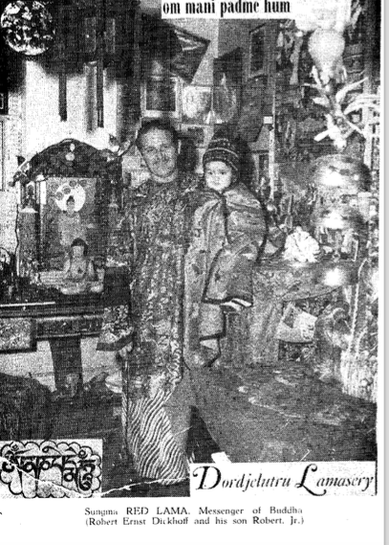
During the next decade—if not before—Ralph’s professional world expanded.  Probably he received his first real exposure doing Western scenes for the Portland-based magazine “Northwest Background.”  At least, he did seem to publish in this magazine, and this work was the most traditional, his later pieces indicating extensive experimentation, which takes time.  In the mid-1930s he became intrigued by Buddhism and travelled to Buddhist temples in San Francisco and Los Angeles; for a time he was director of something he called “American Buddhist Society.”  Likely this was the American Buddhist Society and Fellowship, founded in 1945 by Robert Ernst Dickhoff, who would later try to link UFOs to Buddhist mythology.  (Phillips’s connection to Buddhism seemed to attenuate some over the years: in a 1949 form for the Portland Museum of Art, he made the connection prominent, but he told the Oregon Journal in 1948 he no longer had formal connections to Buddhism.)

Phillips seems to have had a long-standing interest in H.P. Lovecraft and Weird Tales, and this was reflected in his art by the 1940s, when he started to call himself a painter of the “Ultra Weird.”  He explained this as “mystic, occult, weird, macabre, psychic-inspired.”  He also called his work “modern,” which may have been a nod to the likes of Picasso, although it cut across genres.  A few times, at least, he blended his mysticism with his Western scenery, creating images of Native Americans that he thought would interest Spiritualists, who sometimes used Indians as spirit guides.

His methods were occult, too.  He tried to get himself into a detached state of mind so that he could receive inspiration from what he called “the invisible world.”  He worked at night, when he could see (imagine?) strange faces and alien presences outside his window.  Sometimes, the images—and titles—came to him fully formed.  His work was often abstract, but—signs of Fort, occasionally had unexpected clarities.  He told the Oregon Journal, “I start a picture with no idea what the finished product will be.  Often it turns out to be a colorful network of lines, but somewhere in the picture will appear a cat carrying a kitten.  Weird, isn’t it?”

The technique and subject matter can sound like a parody of those who uncharitably criticized abstract expressionism—created around the same time that Phillips was working—as something a kid could doodle.  But Phillips didn’t see it that way.  “Any Tom, Dick, and Harry can paint what he sees, but few can do my type of work.”

Phillips sold paintings to Weird Tales and fanzines; he displayed at science conventions in Los Angeles (1946) and Philadelphia (1947).  Robert Bloch, author of Psycho and another devotee of Lovecraft, owned some of his work, as did Erle Korshak, a Chicago science fiction fan who co-founded Shasta Publishing.

How Phillips became involved with the Bay Area Fortean community is unclear.  In the late 1940s, he was renting an 8x10 room in a mansion near the corner of SW 12th Avenue and Clay in Portland, where his “favorite friend” was an owl that lived in the eaves.   Perhaps he met Haas at a Buddhist temple?  Perhaps he met some of the writers at one of the conventions?  Perhaps they made contact with him to praise his works.  (Haas, after all, was collecting Clark Ashton Smith’s art.)  He also developed a fan in Chingwah Lee, an art dealer in San Francisco’s Chinatown and art critic.  At any rate, it is known that by the late 1940s he was visiting the San Francisco Bay Area for artistic inspiration, meaning he had connections by then—just as Chapter Two was founded.


Add Comment
 
Guru in the Land of Fuck: Henry Miller, part ii 05/24/2010
0 Comments
 
A bit more on Henry Miller, clarifying some of the earlier post, which overstated some points.

Henry Miller was born 26 December 1891 and raised in Brooklyn, New York.  By his own account, he had a happy childhood.  In the 1910s and 1920s, he moved the Greenwich Village, a Bohemian center.  His family had been unreligious, but Miller himself was drawn to religious ideas, and so found himself captivated by many of the Metaphysical movements then current in Greenwich Village>  He played around with Ouija boards, for instance.  As well, he was  drawn to Eastern religions.  Lao Tzu’s Tao Te Ching, was especially influential, as were Herman Hesse’s Siddhartha (on the life of the Buddha) and Sinnett’s Esoteric Buddhism.  He said he always found gurus more interesting than Christ because of their quest for Enlightenment.

“Freedom,” he wrote in the 1950s, “is a misnomer.  Certitude is more like it.  Unerringness.  Because truthfully there is always only one way to act in any situation, not two, nor three.  Freedom implies choice and choice exists only to the extent that we are aware of our ineptitude.  The adept takes no thought, one might say.  He is one with thought, one with the path.”

Miller (whose literary evaluations were always as eccentric as he was: “My encounters with books I regard very much as my encounters with other phenomena of life or thought.  All encounters are configurate, not isolate.  In this sense, and in this sense only, books are as much a part of life as trees, stars or dung.   I have no reverence for them per se.  Nor do I put authors in any special, privileged category.  They are like other men, no better, no worse”) also found himself drawn to the early weird writers: he was in “thrall” to Rider Haggard’s She.  (Indeed, his Books in my Life spends an inordinate amount of time on Haggard.)  He was also a devoted fan of Algernon Blackwood.  These works, and others like them, including the books of Bulwer-Lytton appealed to him as Romantic yawps against the deadening materialism of the time.  He wrote, “around 1880 English novelists of imagination—the writers of ‘romances’—began to introduce into their works the so-called and miscalled ‘supernatural’ element.  Theirs was a revolt against the fateful tendency of the times, the bitter fruits of which we of this generation our tasting.”

It may be that this love of early weird writers and his own religious quest fuelled his interest in Madame Blavatsky’s Theosophical movement—after all, there are a lot of echoes of Bulwer-Lytton in Blavatsky’s writings.  At any rate, he found Theosophy endlessly engaging.  Blavatsky’s Voice of Silence (along with Sinnett’s Esoteric Buddhism) provided his writing with themes, symbols, and character names.

It may also be that Miller was impressed by Blavatsky because he had a life-long interest in finding a unity to all the world—and Blavatsky’s systemization of science, religion, and the occult certainly did that.  Spengler’s The Decline of the West also did something similar.  Miller became fascinated with it, as did many in the Greenwich Village scene.  (Excerpts appeared in one of the Little Magazines.)  It gave an intellectually respectable base to Blavatsky’s speculation.  It also resonated with his own sense of history’s trajectory.  Despite having an exuberant love of life, Miller thought that the world was running down, and Spengler advocated this, with his premonition that the West was on the decline.  Miller wrote in the 1950s:

“That the American way of life is an illusory kind of existence,  that the price demanded for the security and abundance it pretends to offer is too great.  The presence of these ‘renegades,’ small in number though they be, is but another indication that the machine is breaking down.  When the smash up comes, as now seems inevitable, they are more likely to survive the catastrophe than the rest of us.  At least, they will know how to get along without cars, without refrigerators, without vacuum cleaners, electric razors and all the other ‘indispensables’ . . . probably even without money.  If ever we are to witness a new heaven and a new earth, it must surely be one in which money is absent, forgotten, wholly useless.”

Add Comment
 

    Author

    I am a father, husband, and independent scholar living in Folsom California.  I can be reached at joshuabbuhs_at_yahoo_dot_com.

    Picture

    Archives

    December 2011
    October 2011
    September 2011
    July 2011
    May 2011
    April 2011
    March 2011
    February 2011
    January 2011
    December 2010
    November 2010
    October 2010
    August 2010
    July 2010
    May 2010
    April 2010
    March 2010
    February 2010
    January 2010
    December 2009
    November 2009
    October 2009
    September 2009
    August 2009
    July 2009
    June 2009

    Categories

    All
    Abstract Expressionism
    Advertising
    Albert Abrams
    Albert Laws
    Algernon Blackwood
    Aliens
    Allen Ginsberg
    Amazing Stories Quarterly
    Ambrose Bierce
    Anais Nin
    Andres Breton
    Anthony Boucher
    Anti War
    Anton Lavey
    Apollo 18
    Apports
    Astrology
    Automatic Writing
    Avram Davidson
    Beats
    Ben Hecht
    Berkeley Renaissance
    Bern Porter
    Bernard Heuvelmans
    Bfro
    Bigfoot
    Blavatsky
    Bloomsbury Set
    Bohemianism
    Book Of The Damned
    Booth Tarkington
    Buckminster Fuller
    Buddhism
    C. Daly King
    Charles Fort
    Charles Henri Ford
    Chingwah Lee
    Church Of Satan
    Clark Ashton Smith
    Conrad Moricand
    Culture
    D. H. Lawrence
    Damon Knight
    David Bascom
    Di Gava
    Doubt
    Drugs
    E. Hoffman Price
    Ed Ricketts
    Edmund Pearson
    Erle Korshak
    Fortean Geography
    Fortean Society
    Forteanism
    Forteans
    Frank Norris
    Franklin Rosemont
    Galaxy
    Garen Drussai
    Geeks
    General Semantics
    George Bernard Shaw
    George Haas
    George Leite
    George Sterling
    Grover Krantz
    H. G. Wells
    H. P. Lovecraft
    Henry Kuttner
    Henry Miller
    Herman Hesse
    Horace Gold
    If
    Info Journal
    International Fortean Organization
    Isaac Asimov
    J. M. Keynes
    Jack Kerouac
    Jack Parsons
    Jack Spicer
    Jack Williamson
    Jean Varda
    Jeff Meldrum
    John Steinbeck
    John W. Campbell
    Joseph Henry Jackson
    Josephine Miles
    Kathleen Ludwick
    Kenneth Macnichol
    Kenneth Rexroth
    Kenneth Starr
    Kirk Drussai
    Laurence Stallings
    Louis Eytinge
    Magazine Of Fantasy And Science Fiction
    Manana Society
    Marvin Sargent
    Masculinity
    Matt Moneymaker
    Maynard Shipley
    Men's Adventure Magazines
    Mermaids
    Metablogging
    Miriam Allen De Ford
    Multiple Sclerosis
    N Meade Layne
    Neeli Cherkovski
    Nikola Tesla
    Noelle Curtis
    Oakland Tribune
    Ouspensky
    Parker Tyler
    Paul Willis
    Phe Laws
    Philip K. Dick
    Philip Lamantia
    Polly Lamb Goforth
    Ralph Rayburn Phillips
    Ray Palmer
    Richard Lamb
    Rider Haggard
    Robert Allerton Parker
    Robert Barbour Johnson
    Robert Bloch
    Robert Duncan
    Robert Ernst Dickhoff
    Robert Heinlein
    Robert Payne
    Robert Spencer Carr
    Roman Macdougald
    Ron Willis
    Round Robin
    Sam Moskowitz
    San Francisco Chronicle
    San Francisco Renaissance
    Science Fiction
    Sherlock Holmes
    Silicon Valley
    Skeptics
    Socialism
    Spiritualism
    Stanford
    Stwe
    Summerland
    Sun Maps
    Surrealism
    T. Swann Harding
    Theosophy
    Thirteen Ways Of Looking At A Fortean
    Tiffany Thayer
    Ucla
    Ufos
    Virginia Woolf
    Vortex
    Weird Tales
    Weird Tales Of The City
    Weird Tales Of The City
    Wildman

    RSS Feed


Create a free website with Weebly