From an Oblique Angle
  • Blog
  • THINK TO NEW WORLDS
  • Bigfoot: The Life and Times of a Legend
  • The Fire Ant Wars
  • Articles

Egerton Sykes as a Fortean

2/28/2017

0 Comments

 
Picture
​A scholar of Atlantis with a connection to the world of Forteans.

Egerton Sykes was born in London in 1894. I cannot be more specific than that. As a boy, he enjoyed reading Jules Verne, and those stories, particularly “20,000 Leagues Under the Sea” led him to an interest in Atlantis. He started collecting Atlantean literature as a teenager. Friends knew Sykes as “Bill.”

In World War I, he served as a lieutenant in France; he was still a very young man. Shell shock sent him to the hospital. Sykes had some training in engineering, and spoke a number of languages, mostly German, French, and Polish; he went into journalism and diplomacy. From 1930 to 1942, he was stationed in Poland as a foreign correspondent for various newspapers. He continued to grow his collection of Atlantis books, and also helped to get a number of people out of the country as the Nazis became increasingly bellicose. In the 1939 siege of Warsaw, he lost his first Atlantean collection. Reportedly, he lost a son during World War II.


Read More
0 Comments

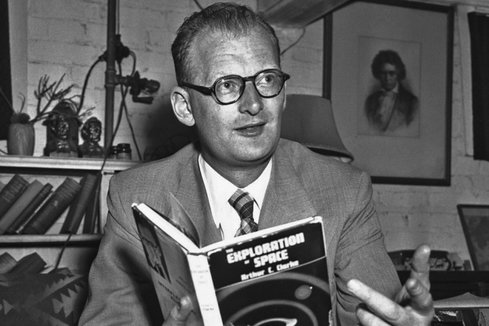
Arthur C. Clarke as a Fortean

2/17/2017

0 Comments

 
Picture
​He cashed in on Forteana, and his writings were influenced by Fort—even as he often bristled at other Forteans.

Arthur C. Clarke is too well known, too written about to warrant anything more than a thumbnail sketch here. Indeed, Bob Rickards wrote about his Forteanism in the January 2015 Fortean Times.

Born 16 December 1917 in Somerset, England, he had an early interest in astronomy and science fiction, eventually becoming one of the early participants of British fandom and a teenage member of the British Interplanetary Society. He served in the RAF during World War II, working on radar, and afterwards graduated from King’s College in London. Clarke did legitimate scientific work—contributing to the idea of geostationary satellites—but made his name as a scientific writer. He was known for being boisterous and opinionated, picking fights and quickly forgetting about them, too.
Read More
0 Comments

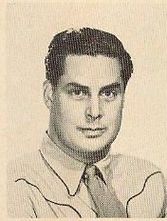
Barry Shipman as a Fortean

2/17/2017

0 Comments

 
Picture
​The movie was unmade, the Society unjoined—but his inclination was Fortean.

Barry Shipman was born 24 February 1912 in Pasadena to Ernest and Nell Shipman, he a theatrical producer and she an actress. Barry grew up on Hollywood studio lots, and accompanied his mother—after her divorce—on location in Big Bear, and at a “movie camp” on the Washington-Idaho border. Later in the 1920s, they moved frequently, through Connecticut, Florida, Spain, and back to California in 1928. Shipman himself went into the entertainment business and, in 1934, married an actress, Beulah McDonald, who went by the stage name Gwynne Shipman. They would have three children, a daughter an twin sons.


Read More
0 Comments

Kathleen Ludwick as a Fortean (Updated and Revised)

2/14/2017

5 Comments

 
Picture
​A mystery no more—a Fortean.
I’ve written about Kathleen Ludwick before, and was not able to find any reliable biographical information. She wrote one science fiction tale, “Dr. Imortelle,” which appeared in a 1930 issue of Amazing Stories. As a result of this piece, others have tried to ferret out something about her life, but have either not gotten anywhere or made incorrect assumptions. In his great resource Science Fiction: The Gernsback Years, Everett Bleiler supposes, based on social security records, that Ludwick was born in Maryland in 1892 and died in New York in 1970. But that doesn’t seem correct.
The Kathleen Ludwick who wrote “Dr. Immortelle” gave her address as Oakland California. And, from the census of 1930, it is known that there was a (different) Kathleen Ludwick in Oakland. That Ludwick says that she was sixty—so born around 1870—and originally from Nevada. There is further reason to suspect that there were two Kathleen Ludwicks living around this time. A search of the name at newspaperarchives.com gives a pot of articles from Pennsylvania and a second lot from Oakland. 


Read More
5 Comments

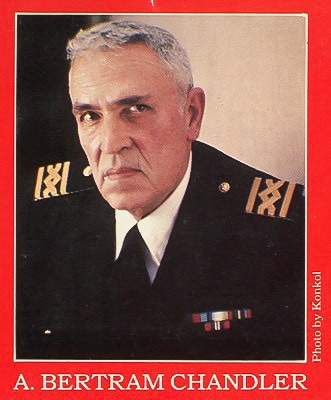
Arthur Bertram Chandler as a Fortean

2/14/2017

0 Comments

 
Picture
​The very model of a major . . . science-fictional Fortean.

Arthur Bertram Chandler was born 28 March 1912 in Aldershot, Hampshire, England. He was the son of Arthur Robert Chandler, a soldier who died in World War I when he was only three, and the former Ida Florence Calver. Chandler grew up in in Beccles, Suffolk, with his brother, his mother, and his mother’s family, where he attended Peddar’s Lane Council School and Sir John Leman School. His maternal grandparents were either, he said, upper working class or lower middle class, and solidly invested in English class status—which he was not. Once, when he was a child, he was thrown out of the house for arguing about King Edward VII’s abdication of the English throne to marry. “But she’s only a commoner,” his grandmother said incredulously. “What the hell does it matter?,” he replied.

Aged sixteen, he left school; as he remembered it, he failed his exams to continue on because of the officiousness of either his teacher or headmaster, and late in life would wonder what his other path would look like. He went to work as an apprentice on a tramp steamer line, working his way to Second Mate. In the mid-1930s—about the time he was thrown out of the house—he returned to landlubbing work, briefly, as he could not find a job aboard a ship. This was the Depression, after all. He did return to the sea soon enough, though, joining Shaw Savill Lines as a Fourth Officer. Chandler married for the first time, 25 May 1938; his wife was Joan Margaret Barnard. His ship ran a line between England and Australasia. With the onset of war, he was a gunnery officer. He obtained his master’s certificate in 1943. Bertram and Joan had three children, two daughters and a son: Penelope, Christopher, and Jennifer (who married the horror writer Ramsey Campbell).


Read More
0 Comments

H. G. Wells as an anti-Fortean

2/8/2017

0 Comments

 
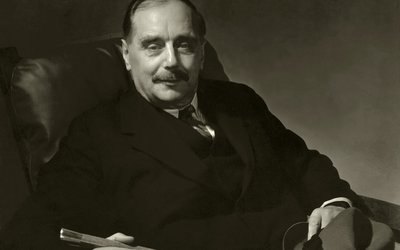
PictureH. G. Wells in 1932.
​Not a Fortean.

H. G. Wells is the towering figure in science fiction. Charles Fort is a source of Fortean ideas and plots. It is inevitable that they some times end up in the same histories. I do not get the sense that anyone mistakes Wells for a Fortean (the same cannot be said for the stridently anti-Fortean H. L. Mencken, who is often co-opted into the movement), but it seems best to reiterate the point: H. G. Wells was not a Fortean.

Even if he was honored by the Society.


Read More
0 Comments

Francis Dillon Brownley as a Fortean

2/1/2017

0 Comments

 
Picture
​Interested in theories of the earth’s hollowness—and a fringe member of the community of Forteans.

Francis Dillon Brownley was born 20 September 1916 in New York to Howard D. Brownley and the former Margaret May. He had an elder brother named James. In 1920, the family lived in Washington, D.C., with Howard’s widowed father and a 16 year-old servant. Howard was the only one in the family working, as a government clerk.; he had earlier served in World War I. Ten years later, the nuclear family—Howard and May, James and Francis—were in Howard’s natal home state of Maryland, where he worked for the Coast Guard.

Some time in the 1930s, the family relocated to the other side of the country, settling in Alameda, California around 1935. The 1940 census has Howard working as a marine engineer at an engine company—probably related to the shipyards outside of Oakland. James had moved out. Francis, now 24, was categorized as a “new worker” and having been unemployed for 12 weeks. He seems to have quit school after his junior year of high school. He went by the name Frank now, using it on official forms, such as his social security application.


Read More
0 Comments

H. Allen Smith as an (Anti-) Fortean

1/31/2017

0 Comments

 
Picture
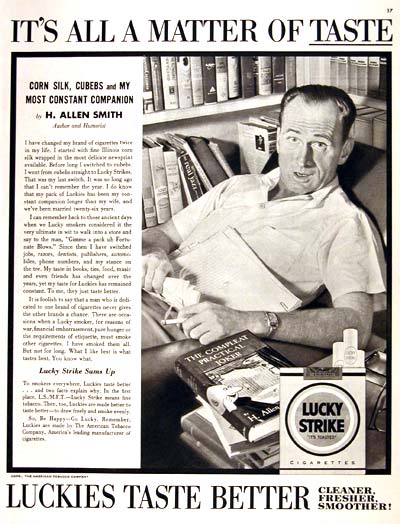
​Harry Allen Smith was born 19 December 1907 in McLeansboro, Illinois, the son of Henry Arthur Smith and the former Adeline Mae Allen. He was the third of nine children. Adeline had planned to name him Henry Allen, but his grandmother had the documents made out in her preferred way: Harry Arthur Smith, Jr. His parents knew nothing of the shenanigans, and called him by the name they thought was his; only later was the subterfuge revealed, and the young Smith opted for Harry Allen—H. Allen as it was later stylized—though he became unsure, thinking it a bit “faggoty.”

His father, at least according to the 1910 census, was in retail bricks, which would seem to mean he sold bricks. He worked on his own accord. The family moved through Illinois, Ohio, and Indiana, during his childhood yearsThe family was in Defiance, Indiana, by 1920, where the elder Harry worked as a cigar maker. Around this time, the younger Harry dropped out of high school, eventually finding himself working as a journalist, beginning, it seems, with a job at the Huntington Press in 1922.

Over the next decade, Smith moved frequently, rural journalist job to rural journalist job: Jeffersonville, Indiana; Louisville, Kentucky; Sebring, Florida. He was sometimes editor, sometimes even part owner of the places he worked. In Sebring, he met the society editor Nelle Mae Simpson, and they became engaged. He did bummed around, from job o job, and even spent time compiling city directories, before moving out to Tulsa, Oklahoma, were he and Nelle wed. They had two children. After a short stay there, he and Nelle moved to Denver, where he followed in the footsteps of Gene Fowler.


Read More
0 Comments

Jesse Ellsworth Douglass as a Fortean (Updated and Revised)

1/30/2017

0 Comments

 
PictureJesse E. Douglass at the University of Minnesota.
​This one is kind of a guess—but a good guess.

And, it turns out: a correct one. I recently received a cache of letters from a family member of this MFS that confirms my (earlier) speculation about his identity, and gives some insight into how he read and thought about Fort, Forteanism, and the Fortean Society.

“Douglas” gets a few mentions in Doubt. The first was in June 1943’s story on ‘Scientifiction,’ in which he is listed as associated with science fiction. That same issue notes he had sent in material, although Thayer did not have the space to consider it. Douglas—or someone with the last name Douglas—received credit five more times. The last also gave a better clue to the identity of the Fortean, as the surname was spelled with two esses, Douglass. (Thayer mis-spelled names a lot.)

But the biggest clues come from the last mention, in April 1955 (issue #48). Thayer notes that the cover of the winter issue—featuring a grimacing face captioned “Joy to the World”—received much praise, so much that some suggested it be made into a Christmas card.Thayer noted that it was a Christmas card, from Jesse Douglas—one S, again—who had joined the Fortean Society as a undergraduate at the University of Minnesota and sent in the card—drawn by a fellow Fortean and Gopher, last name Swisher—from Panama.


Read More
0 Comments

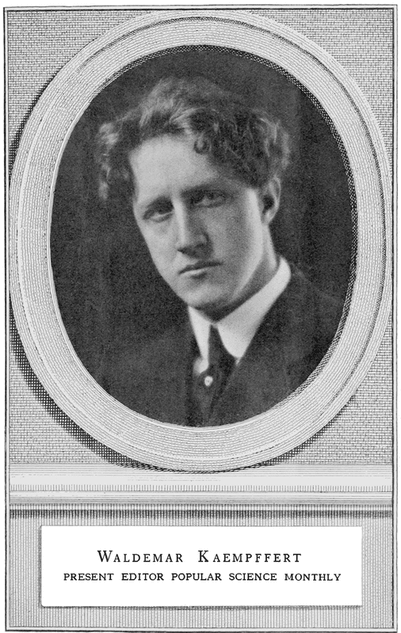
Waldemar Kaempffert as a Fortean

1/27/2017

0 Comments

 
Picture
​Overlooked, but—at least as much because of what he represents as his own activities—an important Fortean.

Waldemar Bernhard Kaempfert was born 23 September 1877 in New York City, making him a contemporary of Charles Fort, who was born upstate, in Albany, three years earlier. His father, Barnhard, was a German immigrant; his mother, the former Juliette Levine, was born in New York to a Russian father and German mother; Barnhard and Juliette were married 15 October 1876. I believe that Waldemar was their eldest child; he had a sister, Magda, two years his junior. I have not been able to find the Kaempfferts in the 1880 or 1900 censuses (the 1890 census was destroyed in a fire), so I do not know what work Barnhard did. He died sometime before 1910, leaving Juliette a widow for the last several decades of her life. Waldemar attended local schools, and graduated from the City College of New York with a Bachelor’s of Science in 1897.

Kaempffert went to work at Scientific American after his graduation; according to Wikipedia, his first job there was translating. In 1900, he became a managing editor; he also continued his education: he received and LL.B. from City College in 1904. In 1910, according to the census, Waldemar was living with his mother and sister on West 105th in Manhattan. Magda, who was divorced, taught at a school; Juliette did not have a job listed. The following year, Kaempffert married Carolyn Lydia Yeaton. During this period,, he was also writing on science for other periodicals—including Harper’s, Cosmopolitan, and McClure’s—and putting out books. In 1905 he translated Mathot’s “Gas-Engines and Producer-Gas Plants” from the French; in 1909 he published “Astronomy,” the first volume in “The Science-History of the Universe”; and in 1911, “The New Art of Flying.”


Read More
0 Comments
<<Previous
Forward>>
Powered by Create your own unique website with customizable templates.
Photo from Marcin Wichary