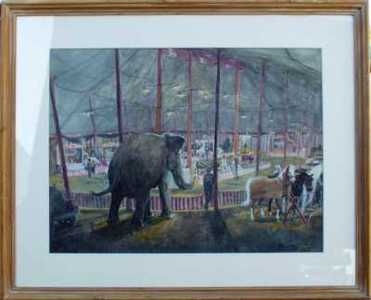
 A painting by RBJ.
 Yet another mysterious Fortean.
This write-up is a revised and (slightly) updated version of a series of posts I first did back in 2009 (!) and 2010. It seems to be the un-cited source for much of the wikipedia entry on the man.
Robert Barbour Johnson was born on 19 August. That much we can say with some certainty. It's the date given on his application for a social security number and on his death certificate. Beyond that, well, there's a range of possible answers. His World War II enlistment card says 1905. His application for social security says 1906. Obviously, there are incentives for making one's self older to get social security earlier. There are also incentives for making oneself younger and some suggestion Johnson relished the idea of being a wunderkind. When his story "Far Below" was chosen as the best yarn ever published in Weird Tales, he was noted as one of the magazine's younger writer. He said that he harassed his writer friends with that for month, pointing out that lots of people say they are young, but he had written proof. His death certificate says 1907 (as does the SSDI). His recollections for The Weird Tales Story suggests that he was born in 1909. Edan Hughes's “Artists in California” has him born in that year as well.
This write-up is a revised and (slightly) updated version of a series of posts I first did back in 2009 (!) and 2010. It seems to be the un-cited source for much of the wikipedia entry on the man.
Robert Barbour Johnson was born on 19 August. That much we can say with some certainty. It's the date given on his application for a social security number and on his death certificate. Beyond that, well, there's a range of possible answers. His World War II enlistment card says 1905. His application for social security says 1906. Obviously, there are incentives for making one's self older to get social security earlier. There are also incentives for making oneself younger and some suggestion Johnson relished the idea of being a wunderkind. When his story "Far Below" was chosen as the best yarn ever published in Weird Tales, he was noted as one of the magazine's younger writer. He said that he harassed his writer friends with that for month, pointing out that lots of people say they are young, but he had written proof. His death certificate says 1907 (as does the SSDI). His recollections for The Weird Tales Story suggests that he was born in 1909. Edan Hughes's “Artists in California” has him born in that year as well.