Thirteen Ways of Looing at a Fortean: II 07/11/2010
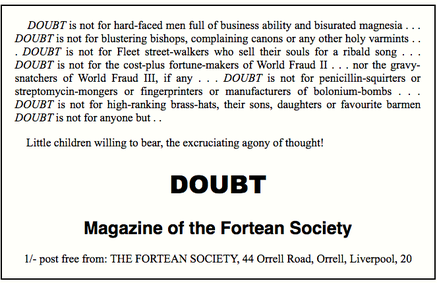
Yeah, so I haven't used this category as much as I thought. But now I am starting to apply a little more thought to exactly what I want to say about the Forteans--or at least some of them--and so thought I might make use of it again. I still have some reading to do, but I think I've finished collecting information on the San Francisco Bay Area Forteans through the 1950s, and so am in the early stages of combining it into what will eventually become an article. But to what end? As noted earlier, thinking about Forteans is one way of thinking about collecting, and what collecting means in a world that becomes increasingly oriented around consumption. From a completely different angle, one can also think of Forteans as superstitious hold-outs--people who turn their back on science to embrace irrationalism and unreason. Certainly, there are plenty of examples in Doubt of Tiffany Thayer standing against reason simply for the sake of standing against reason. Even many Forteans thought so. Add Comment According to Garen Drussai, Kirk spent some time in New York City, where he me Tiffany Thayer, the one man operation behind the Fortean Society. Afterwards, he ended up in Hollywood. Garen Lewis—as Tiffany Thayer called her—and Kirk Drussai met somehow and were drawn together—by Forteanism, Thayer claims. This probably oversells the importance of Foreteanism to them, but there is no doubt that they were both interested in the subject. Kirk Drussai was sending clippings to Thayer and promising a paper on heterodox cancer cures for the Fortean Society’s magazine, Doubt. It never appeared—whether Kirk never wrote it or Thayer never published it is not known. In his introduction to her first short story, Anthony Boucher noted that Garen Drussai was a vigorous debater on matters Fortean. The Drussais seem to have been the motive force behind the organization of the Fortean Society in San Francisco after they relocated to the northern part of the state. (Garen said that they hitchhiked between the northern and southern parts of the state.) Thayer announced in Doubt 21 (published around June 1948): The San Francisco and Bay Area members have met informally as guests of MFS MacNichol, who shares honors for the idea with MFS Drussai [no mention as to which Drussai], and the labors of assembly with MFS di Gava [?].” The meeting was held on 1 April and attendees put their names in a ledger titles “The Book of the Damned.” This founding of Chapter Two, as it was known, came at a time when Tiffany Thayer seemed to be interested in organizing Forteanism a little bit. He suggested a Fortean University, a Fortean arrangement of knowledge, and the announcement of Chpater Twos formation was soon followed by Chapters Three and Four—in Chicago and Dallas—although this burst of organization ended soon enough. Drussais soon became moderator of the meetings, as well as its “Bugler,” or secretary.” Doubt 24, published around April 1949, noted that the Drussais paid dues for their unborn child. This was, Thayer said, The Fortean Society’s Virginia Dare, referring to the first person born to English parents in North America. The Drussais named their son Milo. He was born 21 April 1949. Within a few months, Thayer had overcome his interest in organization, reprimanded the chapters, and stopped reporting on them. A few years later, Garen was turning her attention to writing science fiction, and though the high tide of Chapter two had ebbed, her stories showed that she maintained an interest in Forteanism. As Garen remembered the times from years later, it was a brief, but fun interval, a chance to hang out with young oddballs, in her phrase. I spoke briefly with Garen Drussai in November 2009. At the time, I didn’t have any idea about her name change, and so never talked to her about that. But she did mention that before she met Kirk, she was already a writer of what might be called mainstream articles. Kirk introduced her to science fiction, and its as a science fiction writer that she is best remembered. In an introduction to one of her stories, Anthony Boucher claimed credit for discovering her. Drussai was not a fictioneer in the mold of E. Hoffman Price or Fredric Brown, churning out page after page of copy. As best I can tell, she wrote four works of science fiction, one with Kirk. (Although Robert Barbour Johnson referred to them as a writing team, and the Eric Leif Davin’s Partners in Wonder: Women and the Birth of Science Fiction, 1926-1965 has her as Mrs. Kirk Drussai, she insisted that she was the writer, not Kirk, and Kirk didn’t seem to write any science fiction by himself.) Her stories were “Extra-Curricular,” which appeared in The Magazine of Fantasy and Science Fiction (1952); “Grim Fairy Tale,” which appeared in Vortex (1953); “The Twilight Years” with Kirk, in If(1955); and “Woman’s Work,” also in F&SF (1956). Now although Garen Drussai is best known as a science fiction writer, she has not attracted a lot of attention—unsurprising given her small output. What she has attracted, though, does not serve her well: it’s too limiting. To the extent that her work has been studied, it has been considered as an example of woman’s writings. Critics of her work argue that her stories do not explore, challenge, or subvert the gender stereotypes common to the 1950s. Justine Larbalestier’s The Battle of the Sexes in Science Fiction suggests that later women writers including Joanna Russ, Susan Wood, and Anne McCaffrey were reacting to—and rejecting—the confining vision of Drussai’s vision. After all, her characters reproduce standard-issue mid-century gender roles, the men working, the women housewives and consumers. Stories turned around domestic events. “Grim Fairy Tale,” for example, was told from the point of view of home appliances which had once been enslaved by housewives and now used them as dolls (as well as other humans, presumably). In “:The Twilight Years,” the main male character had worked until retirement, while his wife spent her days shopping. The main character in “Woman’s Work” is a housewife who spends her time fighting off door-to-door salesmen—again, the wife is the family’s chief of consumption and, although this is the future, gender roles have stayed the same. Even Lisa Yaszek, who reads Drussai’s work sympathetically in her book Galactic Subrubia: Recovering Women’s Science Fiction, admits that the focus stays on standard gender relations and domestic environments. Yaszek just thinks that Drussai is satirizing these roles, these places, by showing how conditioned women were to accept their roles. At the end of “Woman’s Work,” Yaszek notes, it becomes clear that Sheila, the housewife in question, is married to a salesman, and he observes her methods of dealing with other salesman to improve his own procedures. Yaszek concludes, “In a world where housewife consumers literally sleep with their enemies, it seems likely that woman’s work will never be done.” At the risk of being overly conciliatory, I think that both these appreciations are fair—Drussai’s work are indeed satires, although they do not usually go beyond satire to suggest other ways of thinking or living. But, seeing her writing as domestic fiction is still too limited. There are other influences. First, it is clear that Drussai, although coming to science fiction late, learned the tropes of the genre, and set out to tweak them. “Extra-Curricular,” for example, is a time machine story, although we do not learn that until the end: what we read about first are three episodes in which something bizarre happens—a baby speaks as an adult, a mistress becomes her lover’s intellectual equal, and an honored woman scientist speaks gibberish at a celebration in her honor. These are certainly domestic issues—mother and baby, man and woman, especially—but they also show the influence of Boucher, who set out on a mission to tweak time machine stories. Only at the end do we realize that a student in the future—doing extra-curricular work—has been dipping back in time and playing around. Similarly, “Grim Fairy Tale” plays around with the evergreen topic of robots becoming masters to humanity, a commentary on the increasing mechanization of life. Meanwhile, the “The Twilight Years” plays around with generational change and the increasing power of television. It is set in a future where after age 60, people are killed with state approval—they are useless and need to make way for the newcomers. In this telling, though, the couple at the heart of the story watch their own impending death on television, as some of the killings have been turned into a television show. All of her stories, in fact, also deploy that old pulp method—so favored, again, by Boucher—of the surprise twist at the end (although “Grim Fairy Tale” telegraphs its end, as does “The Twilight Years” for that matter, which would seem to be more a case of lack of execution and my own familiarity with the generic conventions than an attempt to suggest inevitability). It is possible to see in these stories a clever foresight into future events, as with the best of science fiction. That’s not true of “Grim Fairy Tale”—believing robots our certain master was a mistake many science fiction writers made, as Thomas Disch points out in The Dreams our Stuff Is Made of. But “Woman’s Work” foreshadows the age of spam and ubiquitous advertising, and “The Twilight Years” envisioned “reality television” years before it happened. For my purposes, though, it is also interesting to read these stories from a Fortean perspective. The one that most clearly fits the Fortean pattern is “Extra-Curricular,” for here you have a series of bizarre vignettes—I’m tempted to say Fortean damned facts. These are inexplicable by any known science of the time. And so you then get a way of explaining them that transcends current scientific knowledge. The story, in fact, reads like a bit of Fort, with a string of unusual events, and then a hypothesis (usually an outrageous one, in Fort’s books). “Grim Fairy Tale,” also plays with a Fortean notion—much beloved by science fiction writers, that we are property. In this case, humans are the property of their machines. Less obviously Fortean is a tale that actually appeared in Doubt, the magazine of the Fortean Society. This one was called “The Tainted” and was set in a society in which young boys practiced at becoming warriors so that they could be drafted into an interplanetary conflict at age thirteen. The grandfather, who could remember as far back as the Korean War, bemoaned these developments, seeing the gunplay of the current generation as different from his, because they no longer understood it was play. And he was right: at the end, a small boy gets hold of a real gun and kills his mother. Charles Fort himself didn’t consider pacifism, but as developed by Thayer, an ant-war stance was central to the Fortean ideal. Thayer felt that the mainstream was conditioning the younger generation, tricking it into killing for the fat cats who sat at the top of society. Forteanism, in questioning everything, stood for pacifism. Garen Drussai obviously made the connection—as Boucher attests in the introduction to one of her stories, in which he notes how she was both a passionate Fortean and pacifist. “Woman’s Work” also fits with Forteanism as Thayer developed it. Thayer took a dim view of advertising—it was all propaganda to him, brainwashing the masses. “Woman’s Work” echoed these sentiments. | AuthorI am a father, husband, and independent scholar living in Folsom California. I can be reached at joshuabbuhs_at_yahoo_dot_com. ArchivesDecember 2011 CategoriesAll |

RSS Feed