A couple of weeks ago I did an interview with Wisconsin Public Radio about my book Bigfoot. An edited version of that interview has now been incorporated into an episode of "To The Best of Our Knowledge" about monsters. Enjoy!
|
This Saturday I will be at the Northern California Storybook and Literature Festival from 10am to 5:00pm. The festival is being held at
Maidu Library & Maidu Community Center 1550 Maidu Drive, Roseville 95661 From 2:30 to 3:30 I will be in meeting room 1 for a panel discussion on research and writing. The rest of the time I'll be personing my booth. 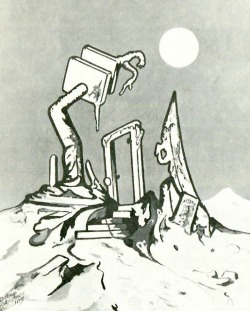 From Destiny 7, Winter 1953. Ralph Rayburn Phillips did not live in the Bay Area—he was a Portlander. But, he did come to the Bay Area often, and was among those who dropped in on the Fortean meetings, at least according to Don Herron. And so I have included him here, among the Bay Area Forteans. There’s not a lot on Phillips, but it is possible to piece together an outline of his life from census records, a file held at the Portland Art Museum, and a brief biographical sketch in the spring 1953 issue of the fanzine Destiny.
Ralph was born to George T. and May G. on 17 October 1896 in Rutland, Vermont. George T. was a native Vermonter—as were his parents—born just after the end of the Civil War in August 1865. May G. was just a little younger than her husband, born in March 1866 to a couple who had emigrated from Canada. They were married in 1892, when both were in their late twenties. George’s father had been a farmer and car inspector; May’s had been a carpenter. George became a dentist. The family seemed to start out in good financial standing: by 1900, they owned their home, free and clear. Ten years later, still in Rutland, Vermont, the house became a bit fuller. According to the census, they took on a boarder from French Canada, and May’s parents, Joseph and Philament Harper were also living with the Phillips. Later evidence also suggests that Ralph had two younger sisters, although they were not captured by the 1910 census. George was the only one working: he was called a “physician.” Ralph was then a student—at “Eastern public schools,” where he studied art. As he remembered much later, Ralph was a rebel from an early age. He told the Oregon Journal in 1970, “I remember walking out of a Baptist Church in anger. I learned early to hate hopeless conformity.” By 1920, the family had relocated to Portland, Oregon, without the boarder or May’s parents, who had likely died by this time. According to a brief biography down for a fanzine, the move came when Ralph was eighteen, so about 1914. George now sold farm implements, which seems a step down in prestige, although the family did still own its home. According to his later recollections, Ralph had continued to study art at high school in Portland, and apprenticed to a commercial artist. The census backs this up, listing his career as commercial artist. (He was still living at home, and so it is likely helped contribute to the family finances.) At some point—maybe in the 1910s, maybe later—he also attended the School of Applied Art in Battle Creek, Michigan. Sometime in the next ten years, George died, and the family’s fortunes declined. By 1930, they had moved into a rental, and Ralph took a new job—as an organizer and salesman for a fraternal order. The monthly rent was a rather steep $25, but the house had to be big enough to fit Ralph, his mother (who was not working), his sister Iris. Iris had just married a marine engineer, James C. Barrie, but he was at sea when the 1930 census was conducted. Nonetheless, the artistic spirit continued to flow through the family. Iris listed her occupation as poet—a brave choice, indeed! Ralph would live in Portland until his death in 1974, going from Bohemian to Beatnik to Hippie. The Oregon Journal reported in 1970, “He has been a familiar figure in the SW Park Blocks for years—tall, silver-haired, simply but neatly dressed, and always barefoot. You usually see him on a park bench, sucking on his pipe, as he reads his latest library book, all the while absent-mindedly wriggling his toes.” During the next decade—if not before—Ralph’s professional world expanded. Probably he received his first real exposure doing Western scenes for the Portland-based magazine “Northwest Background.” At least, he did seem to publish in this magazine, and this work was the most traditional, his later pieces indicating extensive experimentation, which takes time. In the mid-1930s he became intrigued by Buddhism and travelled to Buddhist temples in San Francisco and Los Angeles; for a time he was director of something he called “American Buddhist Society.” Likely this was the American Buddhist Society and Fellowship, founded in 1945 by Robert Ernst Dickhoff, who would later try to link UFOs to Buddhist mythology. (Phillips’s connection to Buddhism seemed to attenuate some over the years: in a 1949 form for the Portland Museum of Art, he made the connection prominent, but he told the Oregon Journal in 1948 he no longer had formal connections to Buddhism.) Phillips seems to have had a long-standing interest in H.P. Lovecraft and Weird Tales, and this was reflected in his art by the 1940s, when he started to call himself a painter of the “Ultra Weird.” He explained this as “mystic, occult, weird, macabre, psychic-inspired.” He also called his work “modern,” which may have been a nod to the likes of Picasso, although it cut across genres. A few times, at least, he blended his mysticism with his Western scenery, creating images of Native Americans that he thought would interest Spiritualists, who sometimes used Indians as spirit guides. His methods were occult, too. He tried to get himself into a detached state of mind so that he could receive inspiration from what he called “the invisible world.” He worked at night, when he could see (imagine?) strange faces and alien presences outside his window. Sometimes, the images—and titles—came to him fully formed. His work was often abstract, but—signs of Fort, occasionally had unexpected clarities. He told the Oregon Journal, “I start a picture with no idea what the finished product will be. Often it turns out to be a colorful network of lines, but somewhere in the picture will appear a cat carrying a kitten. Weird, isn’t it?” The technique and subject matter can sound like a parody of those who uncharitably criticized abstract expressionism—created around the same time that Phillips was working—as something a kid could doodle. But Phillips didn’t see it that way. “Any Tom, Dick, and Harry can paint what he sees, but few can do my type of work.” Phillips sold paintings to Weird Tales and fanzines; he displayed at science conventions in Los Angeles (1946) and Philadelphia (1947). Robert Bloch, author of Psycho and another devotee of Lovecraft, owned some of his work, as did Erle Korshak, a Chicago science fiction fan who co-founded Shasta Publishing. How Phillips became involved with the Bay Area Fortean community is unclear. In the late 1940s, he was renting an 8x10 room in a mansion near the corner of SW 12th Avenue and Clay in Portland, where his “favorite friend” was an owl that lived in the eaves. Perhaps he met Haas at a Buddhist temple? Perhaps he met some of the writers at one of the conventions? Perhaps they made contact with him to praise his works. (Haas, after all, was collecting Clark Ashton Smith’s art.) He also developed a fan in Chingwah Lee, an art dealer in San Francisco’s Chinatown and art critic. At any rate, it is known that by the late 1940s he was visiting the San Francisco Bay Area for artistic inspiration, meaning he had connections by then—just as Chapter Two was founded. Yeah, so I haven't used this category as much as I thought. But now I am starting to apply a little more thought to exactly what I want to say about the Forteans--or at least some of them--and so thought I might make use of it again.
I still have some reading to do, but I think I've finished collecting information on the San Francisco Bay Area Forteans through the 1950s, and so am in the early stages of combining it into what will eventually become an article. But to what end? As noted earlier, thinking about Forteans is one way of thinking about collecting, and what collecting means in a world that becomes increasingly oriented around consumption. From a completely different angle, one can also think of Forteans as superstitious hold-outs--people who turn their back on science to embrace irrationalism and unreason. Certainly, there are plenty of examples in Doubt of Tiffany Thayer standing against reason simply for the sake of standing against reason. Even many Forteans thought so. I’ve looked a little bit at Robert Barbour Johnson’s writings---his mainstream work for Blue Book, his first short story for Weird Tales. As far as I can tell, still no one has punctured the pseudonym(s?) he used for the shudder pulps.
Now, I want to take a closer look at some of his weird stories, which presumably reflected the influence of Fort most of all. I’ve already noted that his first story (although published second), “They” probably grew out of a Fortean understanding of a weird stretch of land on the Monterey Peninsula. After “They,” Johnson wrote “Lead Soldiers” and “Mice.” I have not seen either of these. As far as I can tell, neither was ever reprinted, although Johnson noted that “Lead Soldiers” provoked Lovecraft to write him a fan letter. That story was about Mussolini’s threatening to invade Ethiopia. “Mice,” according to Johnson,” was based on an old French legend he had heard about a curse ending in a nobleman being consumed by mice. He set it in Louisiana, since he had lived there, and based the main character on the detective writer (and friend) Roman MacDougald. Thereafter came a couple year gap, which Johnson blames on the editor of Weird Tales unaccountable animosity. In the late 1930s, he wrote three more stories for Weird Tales. The first published was “The Silver Coffin.” Tame by today’s standards, “The Silver Coffin” is about a scion of a Southern family who is turned into a vampire; he sets himself up in a silver coffin, which he cannot escape, and sets up a trust fund so that the coffin will always be watched over—until, eventually, he dies of starvation. One day, there develops a crack, and he slips out to feast upon local children. The coffin is reinforced with steel. The climax of the story comes when the narrator and visitor see the coffin begin to rattle and hear the screams inside; they are afraid the vampire will escape, but he only tips over the coffin, which is enough to have the visitor faint. The story is told in much the same way as “They”: a visitor meets someone whose job it is to guard a horrible secret; this narrator tells the story of how he came to be in the position to the visitor, who hardly says a word. Very little action occurs in the course of the story. The whole point seems to be the creation of a feeling of foreboding. Johnson’s next story, “Far Below,” is told in much the same way. A man visits the New York subway—although Johnson notes he based it on “Forest Hill Tunnel” in San Francisco—where he meets what amounts to an occult police: a former zoologist who has been tasked to guard a stretch of subway tunnel that is constantly attacked by some bizarre creatures, part ape, part mole. These Johnson borrowed from Lovecraft’s “Pickman’s Model,” although the idea of an occult police may have come from Fort, who wrote about such a force in Book of the Damned. At the end of the story, the visitor notes that the former zoologist is himself turning into one of the creatures. The story was well-received, and continues to be. It was chosen as the best story ever to appear in Weird Tales, received encomiums from critic S. T. Joshi, and was widely reprinted. Again, though, the story is tame by modern standards, lacks action—opting instead to create mood—and distances the reader through Johnson’s narrative device. Nonetheless, it does manage to make subways feel weird—uncanny. Johnson’s final story for Weird Tales was “Lupa.” Like “The Silver Coffin,” “Lupa” was written while Johnson was in San Diego—which he said had a weird vibe in those days just before the war. It, however, has not been reprinted, and so I have not seen it: original copies of Weird Tales are much too expensive. For the most part, Johnson seems to have focused on his writing for Blue Book in the years after World War II. He did write a weird tale for Ray Palmer’s Mystic, which was something of a spin-off of the very Fortean Fate, at least as best as I can tell. The story appeared in the second issue. (Johnson complained he was never paid for it, which, if true, was not unusual.) The story was called “The Strange Case of Monica Lilith.” Johnson varied his narrative technique in this story, at least from what I’ve read of his other material. The story is reported as if from the books of Charles Fort, which again distances the reader and sometimes can lapse into monologue, but also allows for more action. Monica Lilith is hardly in the story at all. She is described as a typical celebrity diva who maintains a suite at a prestigious resort in Tahoe. She has only three quirks that make her stand out from the mass of others of her ilk: her fear of water, refusal to show her shoulders, and an odd pet that no one has ever seen. Lilith dies one day merely by coming in contact with the Lake; her autopsy reveals that she had a third nipple on her shoulder. After that, events get really weird: there are mysterious fires and wrecked rooms. Staff and guests are driven away. It comes to pass that her pet is angered at Lilith’s death and is wreaking vengeance. And the pet is no normal pet, but something out of a Bosch painting, a demon familiar that apparently suckled at Lilith’s breath. Eventually, it is caught and killed . . . and the story forgotten. After this story, Johnson seems to publish almost nothing. His run at Blue Book ended. Weird Tales was no more, as were the shudder pulps. He did do an article for a fanzine on the death of fantastic fiction, and his essay on the Fortean society was reprinted. But then, in 1964, The Magazine of Horror published his “The Life-After-Death of Thaddeus Warde.” It was reprinted two years later in America, and also was translated into the French. In this story, Thaddeus Warde, a member of the idle rich, seems to die of a self-inflicted gunshot wound. He is embalmed and buried—but crawls back to the surface to hunt down the man who killed and cuckolded him. The story itself lacks drama, and the surprise ending is no surprise. It is an attempt, again, to evoke a feeling of oddness. It is told as a case report, just as his previous story had been, like something out of Fort: this story proving that death is not the end, although what drives one into the afterlife is not the happy thoughts of spiritualism or religion. |
